- 9030350101
- ppkokapet@podarprep.com


Screen Time vs Play Time: Smart Swaps Every Parent Can Actually Stick To
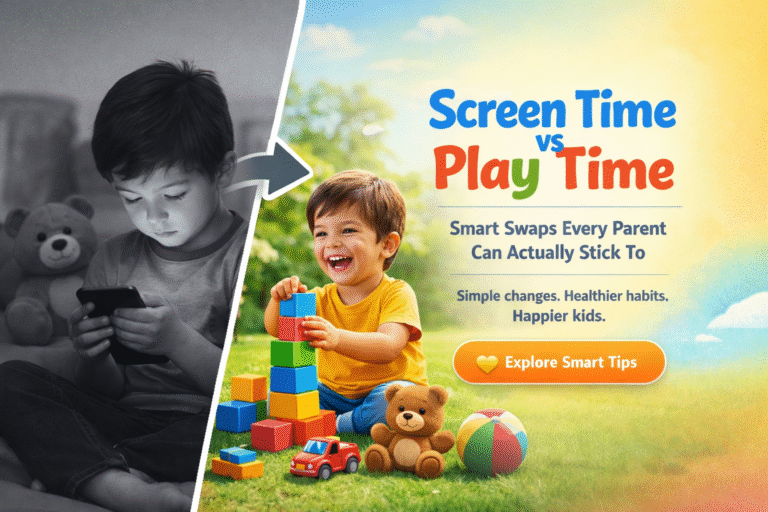
Screen Time vs Play Time: Smart Swaps Every Parent Can Actually Stick To
Introduction: The Screen Time Dilemma Every Parent Knows Too Well
It’s 6:30 PM. Dinner isn’t ready. Your toddler is melting down. And the tablet is right there — one tap away from ten minutes of peaceful cooking.
We’ve all been there.
Screen time has quietly become one of the most contested parenting topics of our generation. And yet, most conversations around it swing to extremes: either “ban all screens” or “it’s fine, don’t stress.” Neither of those helps a real parent on a real Tuesday evening.
At P-Prep Kokapet — one of the most trusted preschools in Kokapet — we believe in practical, compassionate solutions that actually work for modern families. This blog isn’t here to guilt you. It’s here to give you smart, doable swaps that replace passive screen time with active, joyful play — the kind that builds your child’s brain, not just entertains it.
Let’s get into it.
Why Screen Time Isn’t the Enemy (But Too Much Of It Is)
Before we talk about swaps, let’s be clear: screens aren’t inherently evil. Educational apps, video calls with grandparents, and age-appropriate shows all have a place in family life. The concern isn’t the screen itself — it’s what children miss out on when screens replace play.
Here’s what research tells us:
- Children aged 2–5 need at least 3 hours of physical activity per day
- Unstructured play is critical for developing emotional regulation, creativity, and problem-solving
- Excessive screen exposure before age 5 has been linked to delays in language and social development
- The American Academy of Pediatrics recommends no more than 1 hour/day of high-quality screen time for children aged 2–5
At a quality preschool in Kokapet, children naturally get the stimulation, movement, and peer interaction that screens simply can’t replicate. But what about the hours spent at home?
The 7 Smart Screen-Time Swaps That Actually Stick
The secret to making any swap work is meeting your child where they are. Instead of snatching the device away and declaring “go play,” try bridging from what they love on screen to a real-world version.
Swap #1: Cartoon Watching → Puppet Show Creating
Instead of: Passively watching animated characters Try: Building a simple puppet show with socks, paper bags, or stuffed animals
Why it works: Children who love cartoons are drawn to characters and storytelling. When they become the storyteller, they develop narrative thinking, vocabulary, and creativity — skills that form the backbone of early literacy.
Quick tip: Ask your child to recreate their favourite cartoon episode using their toys. You’ll be amazed at the stories they tell.
Swap #2: YouTube Kids → Nature Scavenger Hunts
Instead of: Watching others explore and discover Try: Heading outside with a simple scavenger hunt list
Why it works: Most children watch nature and exploration videos because curiosity is hardwired into them. Give that curiosity a real-world outlet — find five different leaves, spot three types of birds, or count the number of ants near a crack in the pavement.
Quick tip: Make a “nature journal” from an old notebook. Children feel proud documenting their own discoveries.
Swap #3: Gaming → Board Games and Card Games
Instead of: Screens that deliver instant, solo stimulation Try: Age-appropriate games like Snakes & Ladders, Memory, or Uno (Junior)
Why it works: Games teach children to wait their turn, manage frustration, follow rules, and celebrate others’ wins — all essential social-emotional skills that no algorithm can teach. Bonus: it becomes bonding time for the whole family.
Quick tip: Keep a “game basket” accessible at eye level so children can suggest games themselves. Ownership builds enthusiasm.
Swap #4: Tablet Drawing Apps → Hands-On Art and Craft
Instead of: Swiping digital brushes on a screen Try: Real paints, crayons, clay, or simple collage-making
Why it works: Touch-screen art removes the sensory richness that actual art materials provide. The feel of clay, the smell of paint, the texture of torn paper — these experiences build fine motor skills and sensory integration in ways digital tools cannot.
Quick tip: Don’t worry about the mess. Lay down a newspaper sheet and let them go wild. The clean-up itself is a learning activity.
Swap #5: Music Videos → Dance and Movement Games
Instead of: Watching performers dance Try: Freeze dance, musical chairs, or simple choreography sessions
Why it works: Movement is medicine for young children. Gross motor development, body awareness, coordination, and even early maths (counting beats) are all woven into active music play.
Quick tip: Let your child be the DJ — they pick the song, you both freeze when it stops. Role reversal makes them feel powerful and engaged.
Swap #6: Passive Educational Apps → Cooking Together
Instead of: Tapping through “educational” games on auto-pilot Try: Inviting your child into age-appropriate kitchen activities
Why it works: Cooking with children is a masterclass in real-world learning. Measuring ingredients = maths. Reading a recipe = literacy. Mixing and pouring = science. Following steps = executive function. And the reward? Something they helped create and can eat.
Quick tip: Let them stir the dough, wash the vegetables, or arrange fruit on a plate. Even toddlers can participate meaningfully.
Swap #7: Bedtime Screen Time → Story Time Rituals
Instead of: Devices as a wind-down routine (which actually delays sleep) Try: A consistent bedtime story ritual with physical books
Why it works: Screens emit blue light that suppresses melatonin, making it harder for children to fall asleep. Stories, on the other hand, calm the nervous system, build vocabulary, and create a sense of safety and closeness that screens simply cannot replicate.
Quick tip: Let your child pick the book. Reading the same book ten nights in a row isn’t boring to them — it’s comfort. And every re-read builds deeper comprehension.
How Preschool Helps Children Make the Shift
One of the most overlooked aspects of the screen time conversation is how much easier balance becomes when children are engaged in rich, stimulating environments during the day.
When a child spends their day in a quality preschool in Kokapet — one that prioritises play-based learning, sensory exploration, peer interaction, and hands-on discovery — they arrive home with their curiosity already sparked. They’re more likely to continue playing, building, and creating in the evening because that’s become their natural mode.
This is exactly the environment we’ve cultivated at P-Prep Kokapet. Our curriculum is designed around the belief that children learn best through doing — through sand and water play, storytelling circles, art exploration, movement games, and collaborative projects that make screen time feel far less appealing than the real thing.
Don’t just take our word for it — read what our families say on our parents’ testimonials page.
Realistic Expectations: What Balance Actually Looks Like
We want to be honest with you: balance doesn’t mean zero screens. It means intentional screens.
Here’s a simple framework many families find helpful:
The “Play First” Rule Before any screen time is granted, at least 30–60 minutes of active, unstructured play must happen. When play comes first, children are more settled, and screen time feels like a natural wind-down rather than a desperate coping mechanism.
Screen Time With Purpose Not all screen time is equal. A 20-minute video call with a grandparent is vastly different from 20 minutes of autoplay videos. Be selective and co-watch when possible.
Consistent Screen-Free Zones Mealtimes, bedrooms, and the first hour after school are powerful screen-free zones. These don’t need to be policed — just modelled consistently by adults.
Communicate, Don’t Command Instead of “put the tablet away NOW,” try “we have five more minutes, then we’re going to build something together.” Giving children a transition warning and something to look forward to makes the hand-off smoother for everyone.
A Note to Parents Who Feel Guilty
If you’re reading this and feeling the weight of parenting in a screen-saturated world — you’re not alone, and you’re not failing.
Every parent uses screens sometimes. Every parent has handed over a device to survive a long flight, a difficult day, or a moment when they simply needed five minutes. That’s not bad parenting. That’s humanity.
What matters is the overall pattern — not the individual moments. If your child has space to play, explore, imagine, connect, and create on most days, you’re doing beautifully.
The parents we work with at our preschool in Kokapet are thoughtful, caring, and deeply invested in their children’s wellbeing. We see it every day. And we’re here to support that journey — not judge it.
Conclusion: Small Swaps, Big Futures
The goal was never to eliminate screens entirely. The goal is to ensure that play — messy, loud, creative, imaginative, collaborative play — remains at the centre of early childhood.
Each swap in this list is small on its own. A puppet show instead of a cartoon. A scavenger hunt instead of YouTube. A bedtime story instead of a device. But strung together over weeks and months, these small choices build something profound: a child who knows how to be curious, creative, and connected to the world around them.
And that child? They’re ready for everything school — and life — will bring.
If you’d like to learn more about how P-Prep Kokapet supports whole-child development through play-based learning, we’d love to hear from you. Explore our approach at pprepkokapet.com and discover why so many Kokapet families have made us their trusted early learning home.
Frequently Asked Questions (FAQs)
Q1. How much screen time is appropriate for a preschool-aged child? The American Academy of Pediatrics recommends no more than one hour per day of high-quality, co-viewed screen time for children aged 2–5. For children under 18 months (except video calls), screen time is best avoided altogether. Quality matters just as much as quantity — educational, interactive content is far preferable to passive viewing.
Q2. My child throws tantrums when I take away the screen. What can I do? Tantrums around screen removal are extremely common and are rooted in how screens stimulate the dopamine system. The most effective strategy is to give a transition warning (“five more minutes, then we play”), offer an appealing alternative activity, and be consistent. Over time, children adapt — especially when play-based alternatives become genuinely exciting to them.
Q3. Are educational apps worth it for preschoolers? Some educational apps can reinforce specific skills like letter recognition or counting. However, research consistently shows that human interaction and real-world play are far more effective for building foundational cognitive and language skills. Apps work best as a supplement, not a primary learning tool.
Q4. How does attending a preschool reduce screen time dependency at home? When children are engaged in rich, stimulating learning environments during the day — like those offered at our preschool in Kokapet — they arrive home with their curiosity and social needs already met. This naturally reduces the pull toward screens as a primary source of stimulation. A full, engaged day leads to healthier, more balanced evenings.
Q5. What if both parents work and rely on screens to manage the child in the evenings? This is one of the most common real-life challenges families face, and there’s no shame in it. The key is building a small library of “quick win” activities that take no preparation: a box of blocks, a simple puzzle, a kitchen drawer with safe containers to stack. Even 15–20 minutes of active play before screen time creates a meaningful difference. Start small and build from there.
Q6. Why is play-based learning emphasised at preschool rather than screen-based learning? Play-based learning activates multiple developmental domains simultaneously — cognitive, physical, emotional, and social. When a child builds a block tower, they’re problem-solving, developing fine motor control, learning cause-and-effect, and often collaborating with peers. No screen application can replicate this multidimensional experience. This is why leading early childhood educators and researchers worldwide consistently advocate for play as the primary mode of learning in the early years.
Q7. What makes P-Prep Kokapet different from other preschools in the area? P-Prep Kokapet is committed to a holistic, child-centred approach that prioritises play, exploration, and emotional wellbeing alongside academic readiness. Our qualified educators create environments where children feel safe to take risks, be creative, and develop at their own pace. Hear directly from our families on our parents’ testimonials page.